
How to Choose the Right Pet Pee Pad Supplier for Your Brand – 6 Key Factors
Introduction
Finding a reliable pet pee pad supplier is critical for pet brands, distributors, and retailers. A poor choice can lead to inconsistent quality, high complaint rates, and damaged reputation. But with thousands of manufacturers online, how do you evaluate which one truly fits your needs?
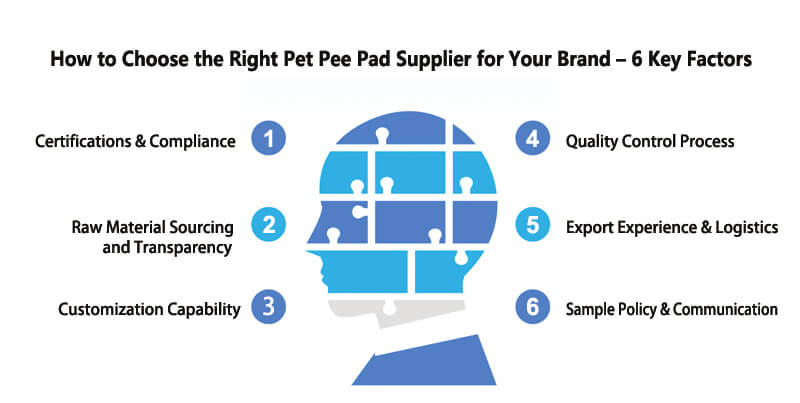
Below are six key factors to consider before signing a contract or placing a bulk order.
1. Certifications & Compliance
A professional manufacturer should hold internationally recognized certifications that cover quality, environment, food safety, and product safety.
What to look for
- ISO 9001 (quality management)
- ISO 14001 (environmental management)
- BRC & HACCP (food safety – important for absorbent pads that contact fresh food)
- CE certification (product safety for EU markets)
Why it matters: These certificates prove the factory follows strict controls, reduces your import risk, and helps you meet regulatory requirements.
2. Raw Material Sourcing and Transparency
The performance of a pet pad largely depends on its materials – non-woven fabric, SAP (super absorbent polymer), fluff pulp, and PE film. A trustworthy supplier should be able to tell you the origin and grade of these materials.
Questions to ask
- Where do you source your SAP and pulp?
- Can you provide material test reports?
- Do you offer alternative materials (e.g. charcoal or plant-based deodorizing layers)?
3. Customization Capability
Bulk buyers often need specific sizes, absorbency levels, colors, edge seals, or custom packaging. A rigid “one-size-fits-all” supplier may not meet your brand’s unique requirements.
Check for flexibility in
- Pad size (e.g. 33x45cm, 45x60cm, 60x90cm, or fully custom)
- Absorbency level (light, medium, heavy, overnight)
- Color and logo printing on the pad or bag
- Packaging type (Transparent PE bag packing, Milky white PE packing, Case Packing, Plastic woven bag packing)
4. Quality Control Process
Consistent quality is non-negotiable. Ask how the supplier monitors production from incoming raw materials to finished goods.
Key QC steps to expect
- Incoming material inspection
- In-line weight and thickness monitoring
- Rewet and absorbency speed testing on random samples
- Leak-proof edge inspection
- Final packaging check before shipment
A reliable factory will provide batch test reports upon request.
5. Export Experience & Logistics
An experienced supplier understands international shipping, documentation, and target market requirements. This saves you time and avoids costly delays.
What to verify
- Which markets do you regularly export to? (e.g. USA, Europe, Japan, Korea)
- Do you have experience with customer’s specific documentation? (e.g. bill of lading, certificate of origin, customs clearance forms)
- What are your lead times for sample and bulk orders?
- Do you offer FCL, LCL, or air freight options?
6. Sample Policy & Communication
Before committing to a large order, always request samples. A professional supplier will have a clear and reasonable sampling policy.
Ideal sample terms
- Free sample (buyer pays shipping) or low-cost sample pack
- 2–5 days for existing design; 7–10 days for custom samples
- Clear communication on specifications and pricing
Fast, responsive communication during the sampling phase is a good indicator of future cooperation.
Final Thoughts
Choosing the right pet pee pad supplier is not just about price. It’s about long-term partnership, consistent quality, and the ability to grow together. Use the six factors above as your checklist, and don’t hesitate to ask for documentation, test reports, and samples.
Sundly is an experienced OEM manufacturer with ISO9001, ISO14001, BRC, HACCP, and CE certifications, 10+ years of export to the US, Europe, Japan, and Korea, and a flexible customization process.