
Industry R&D Trends: Fresh Food Absorbent Pads Shift from Passive Absorption to Active Preservation
In traditional fresh food packaging, plastic wrap serves as a physical barrier – isolating the product from ambient air to slow oxidation and moisture loss. However, this “passive isolation” approach has clear limitations: it cannot contain the juices naturally released by the food itself, which accumulate inside the package and actually accelerate microbial growth. Moreover, direct contact between plastic and food raises growing consumer concerns about microplastic migration.
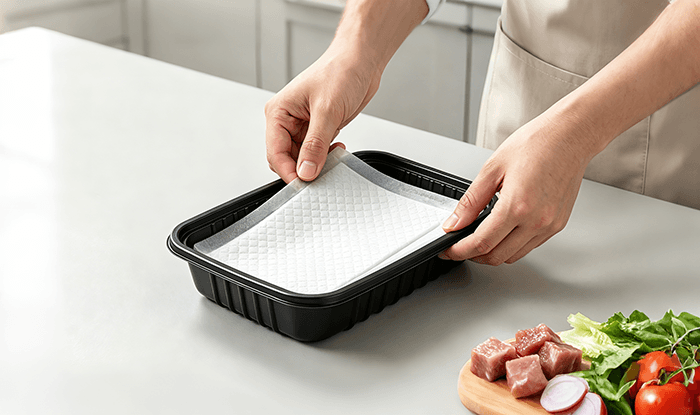
Active Packaging: The Evolution of Absorbent Pads
Recent industry R&D trends indicate that fresh food absorbent pads are evolving from simple “liquid soakers” into active packaging materials with integrated antimicrobial, antioxidant, and smart-responsive functionalities. Novel materials such as hydrogels and aerogels are being incorporated into pad designs. These materials not only improve absorption and fluid retention but also enable the incorporation of natural antimicrobial agents (e.g., essential oils, plant extracts) to actively regulate the micro-environment within the package.
Three Key Technology Pathways
Bio-based Materials Replacing Plastics
The EU-funded REDYSIGN project is advancing the use of wood-fiber-based bio-materials in absorbent pads. By arranging cellulose fibers into innovative three-dimensional structures, these pads can absorb up to 25% more moisture with the same fiber content.
Smart-Responsive Preservation Pads
Researchers have developed smart absorbent pads with pH-responsive and humidity-responsive functions that can sense changes in the package environment and actively release antimicrobial agents. For instance, one study developed a pH/polyphenol dual-responsive smart hydrogel absorbent pad that extends the shelf life of chilled pork by 2 to 4 days. Another study created a multifunctional cellulose-based hydrogel absorbent pad that, through active humidity regulation and antimicrobial action, extends blueberry freshness from 4 days to 12 days.
High-Efficiency Antimicrobial Technologies
Multiple studies have demonstrated that absorbent pads loaded with natural antimicrobials – such as essential oils and plant extracts – show significant inhibitory effects against common foodborne pathogens including E. coli and Staphylococcus aureus. A super-absorbent antimicrobial cryogel pad based on a gelatin-sodium alginate composite has been shown to extend the shelf life of prawns to 6 days.
Market Growth: Steady Rise in Demand
From a market perspective, the fresh food absorbent pad industry is on a steady upward trajectory. According to QYResearch, global sales of fresh food absorbent pads reached $216 million in 2025 and are projected to reach $328 million by 2032, representing a compound annual growth rate (CAGR) of 6.4%. Another report indicates that the global food packaging absorbent pad market was valued at approximately $772 million in 2025 and is expected to reach $1.08 billion by 2032. The market is shifting from basic absorption functions toward higher-value-added products that incorporate antimicrobial, odor-control, and smart-indicator features.
SUNDLY’s R&D Direction: Making Absorbent Pads “Actively Preserve”
Against this industry backdrop, Dalian Sundly Home Products Co., Ltd. (SUNDLY) is actively developing next-generation fresh food absorbent pads.
SUNDLY’s current exploration focuses on upgrading absorbent pads from “passive absorption” to “active preservation.” Building on its mature existing product technologies, the R&D team is tackling two key dimensions: material functionalization and preservation mechanisms. The goal is to deliver a safer, more sustainable, and longer-lasting preservation solution for fresh food packaging – one that enhances product freshness and shelf performance in cold-chain logistics and retail settings.
With over a decade of experience in absorbent products, SUNDLY holds more than 30 utility model patents and has established a well-developed R&D system. Development of the new-generation fresh food absorbent pad is progressing steadily, with further product details to be unveiled at the official launch. SUNDLY remains committed to driving product upgrades through technological innovation, providing global customers with safer and more sustainable fresh-food packaging solutions.
Data Sources: QYResearch, Global and Chinese Fresh Food Absorbent Pad Market Status and Future Development Trends 2026-2032; QYResearch, Global Food Super-Absorbent Pad Market Research Report 2026; Market Publishers, Global Food Packaging Absorbent Pads Market 2026; REDYSIGN Project (EU-funded) official release; Chemical Engineering Journal / Nanjing Agricultural University Sanya Research Institute; Food Research International.